
An external observer might assume that most lawyers have boundless confidence. As a former Barrister and now keynoter and Executive Confidence Coach, I can assure you they do not. Whilst lawyers might be articulate, astute and capable of demonstrating high competence under pressure, they are often working with lifelong confidence challenges, just like everyone else, and just like me.
Why Law Activates Confidence Triggers
The legal profession attracts conscientious, capable and highly responsible people. These qualities help lawyers prepare carefully, anticipate risk, protect clients and maintain high standards. Yet under chronic pressure, the very qualities that support excellence can distort into patterns that undermine wellbeing and confidence.
A commitment to excellence can become perfectionism. A strong sense of responsibility can become over-responsibility. A desire to serve clients well can turn into chronic people pleasing. Self-deprecation and low self-appreciation can become impostor tendencies or the more intense version, impostor syndrome.
These patterns arise because getting legal work right matters, stakes are high, the pace is relentless and the professional culture often rewards availability, precision and endurance. Over time, the nervous system learns that switching off is unsafe, mistakes are intolerable, and saying no may be dangerous.
Many lawyers, when they feel safe to reveal vulnerabilities present as both overwhelmed by the constant busy and victimised by endless thought. Even when the laptop is closed, the mind continues reviewing, rehearsing and scanning for what might have been missed. It may look like down time from the outside, yet inside there can be pressure, vigilance and a quiet sense of never quite being able to relax.
Let’s pause here though, to acknowledge all the law firms that have worked hard and continue to evolve their cultures to move them away from blame-laden hierarchies into learning cultures with a growth mindset. I have the pleasure of working with many of these.
Why Senior Lawyers Are Still Vulnerable
It is tempting to imagine that confidence issues disappear with seniority. In practice, the opposite can also be true. Seniority increases visibility, responsibility and consequence. Success brings larger matters, more complex clients, bigger teams and greater exposure. The more senior the lawyer, the more pressure there may be to appear calm, certain, self-sufficient and to bring in new clients to the firm which requires additional socialising and time away from both billing and home life.
Many senior lawyers also feel they have less permission to admit the struggle. The inner pressure becomes: At my level, I should have all of this under control.
There is another issue. Lawyers are trained to spot flaws, test assumptions, anticipate risk and identify weakness in an argument. These are essential professional skills. Yet when turned inward without compassion, they can become a harsh internal cross-examination.
The mind begins to ask:
Why did you not see that sooner?
How could you have missed that?
What will they think of you now?
Are you really good enough for this level?
The confidence challenges of senior lawyers usually arise when they have insufficiently developed inner capacities for self-awareness, self-compassion, and resourcefulness which shows up as a tendency to ruminate, stew, self-judge and a reluctance to seek help. The outcome of this recipe: insufficient recovery and exponential stress.
So let’s break down some of the most common confidence challenges and point towards their antidotes.
Confidence Killer 1: Impostor Syndrome
Impostor syndrome is the internal experience of believing that you are less competent than others perceive you to be. For lawyers, this can be particularly acute because professional credibility is so closely linked with knowledge, judgement and composure. If you are used to being the person that others come to for answers, it can feel uncomfortable to admit uncertainty, ask for time, or say, I need to check.
These feelings often become more intense at moments of stretch: stepping into partnership, leading a new client relationship, entering a new practice area, returning from leave, or facing the current AI transformation of legal practice. When the professional landscape changes quickly, even senior lawyers can feel as though the ground beneath their expertise is shifting.
Antidote 1: Conscious Self-Talk
One of the most powerful antidotes to impostor tendencies is conscious, emotionally intelligent self-talk. This is a practice of professional self-regulation allowing the mind to return to evidence, perspective and action.
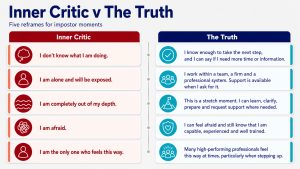
Confidence Killer 2: Perfectionism
Perfectionism gets confused with excellence. This is especially true in law, where precision matters and mistakes can have serious consequences. Care, accuracy and rigour are essential. The difficulty begins when excellence becomes fused with personal worth.
Perfectionism says: Only flawless is good enough.
This founds a brittle form of confidence. It may hold while everything is going well, but it cracks quickly when challenged by error, ambiguity, criticism or delay. The perfectionist lawyer may spend too long refining work beyond what is proportionate, struggle to delegate, become defensive when challenged, or find it difficult to appreciate success. The mind focuses on the tiny imperfection rather than the overall value delivered. Beneath all of this is a human being who believes at some level that their self-worth is dependent on moment-to-moment performance.
Perfectionism also has a time cost, an energy cost and a relationship cost. It can lead to overwork, micromanagement, reduced creativity and a constant sense of internal pressure. At its root, perfectionism is often an attempt to feel safe through control.
This is particularly challenging for senior lawyers because the work often contains genuine complexity. There may be competing risks, incomplete facts, difficult clients, urgent timelines and commercial realities. A lawyer trying to remove all uncertainty will end up exhausting themselves and burning out their team.
Antidote 2: Optimalism
The antidote to perfectionism is optimalism. (Note that does not say optimism).
The optimalist still cares about excellence. They still prepare, think carefully and hold appropriate standards. The difference is that they remain in relationship with reality. They can assess context, constraints, proportionality and purpose.
Perfectionism asks, How can I make this flawless?
Optimalism asks:
What matters most here?
What level of detail is proportionate?
What is the best achievable outcome within the real constraints?
What can be learned?
What is good enough for the purpose?
This distinction is especially useful for lawyers because legal work is full of very real constraints: time, budget, evidence, instructions, risk appetite, incomplete information and commercial pressure. The pursuit of perfect becomes disproportionate. Optimalism restores balance, judgement and is more humane.
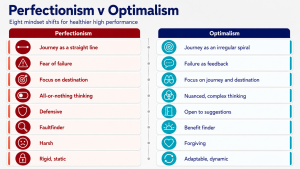
From The Pursuit of Perfect by Tal Ben Shahar.
Confidence Killer 3: People Pleasing
People pleasing can be difficult to spot in law because it often disguises itself as commitment, service and responsiveness. The people pleasing lawyer is helpful, available and constructive. They want clients to feel supported. They want colleagues to feel they can rely on them. They want to be seen as calm, capable and easy to work with. These are valuable qualities. The difficulty begins when helpfulness becomes self-abandonment.
People pleasing may show up as saying yes to work that should be declined, taking on responsibility that belongs elsewhere, giving premature answers, avoiding necessary challenge, softening advice too much, or failing to hold a boundary with a client or colleague.
The underlying belief may be:
If I disappoint them, I will lose standing.
If I say no, I will seem difficult.
If I challenge this, I will damage the relationship.
If I am always useful, I will be safe.
For senior lawyers, this can become particularly draining. Their role often involves holding clients, teams, commercial expectations and institutional relationships. The desire to be useful can gradually become a pattern of over-functioning.
People pleasing also weakens judgement. Sometimes the most helpful thing a lawyer can do is say the clear thing, set the limit, challenge the assumption, or slow the client down. When the fear of disapproval becomes too strong, the lawyer may avoid the very conversation that would build trust.
Antidote 3: Values-Led Boundaries
The antidote to people pleasing is values-led boundaries.
A boundary does not need to be defensive, abrupt or apologetic. At its best, it is an expression of clarity, service and professional integrity. A boundary delivered skilfully is both impressive and can build relationship. The key is to connect the boundary to the value it protects.
For example:
To give this proper attention, I would need until Friday.
I can assist with X, but Y sits outside my involvement.
I don’t want to answer that without checking the linked material.
I can help, but I can’t take this on today without moving another priority.
That timescale is too compressed for the level of review required. Is there flexibility?
A values-led boundary says, I am protecting the quality of the work, the clarity of the relationship and the sustainability of my contribution.
For lawyers, this is essential because the demands are infinite. Without boundaries, professional commitment becomes personal depletion.
Final Thought
If you are reading this and wondering whether you will ever move through your own confidence challenges, please know this: many of the lawyers who reach the highest levels of the profession have lived through moments where they felt shamed, humiliated, belittled, or exposed – and they came through them.
The confidence that senior lawyers develop over time is not impregnable. It still has human edges. Yet those who cultivate the skill of Conscious Confidence, the title of my forthcoming book, learn how to find their way back home: back to centre, back to the breath, back into the body, and back into the heart of confidence itself. From that place, they can restore their equilibrium and respond in ways that are aligned with their values.
Confidence is not something we are born with. It is something we build – again, and again.
And if you take nothing else from this article, take this: reaching out for support is not a failure of confidence.
Very often, it is the beginning of strengthening it.
By Neil Seligman
Neil Seligman is a pioneer in the field of conscious leadership and a passionate advocate for mindfulness, confidence, and spiritual growth at work and in life. He is the author of The Conscious Witness Handbook, Conscious Leadership, and 100 Mindfulness Meditations, and the Founder of The Conscious Professional.
Ready to go deeper? Here are three ways to connect:
1. Explore Keynotes and Team Trainings: Let’s Talk
2. Explore 1:1 Coaching or Energy Work: Schedule Here
3. Try our 10-day online mindfulness course: Zen in Ten